
Faux Rock vs. Real Rock Waterfalls: Which Is Right for Your Pool?
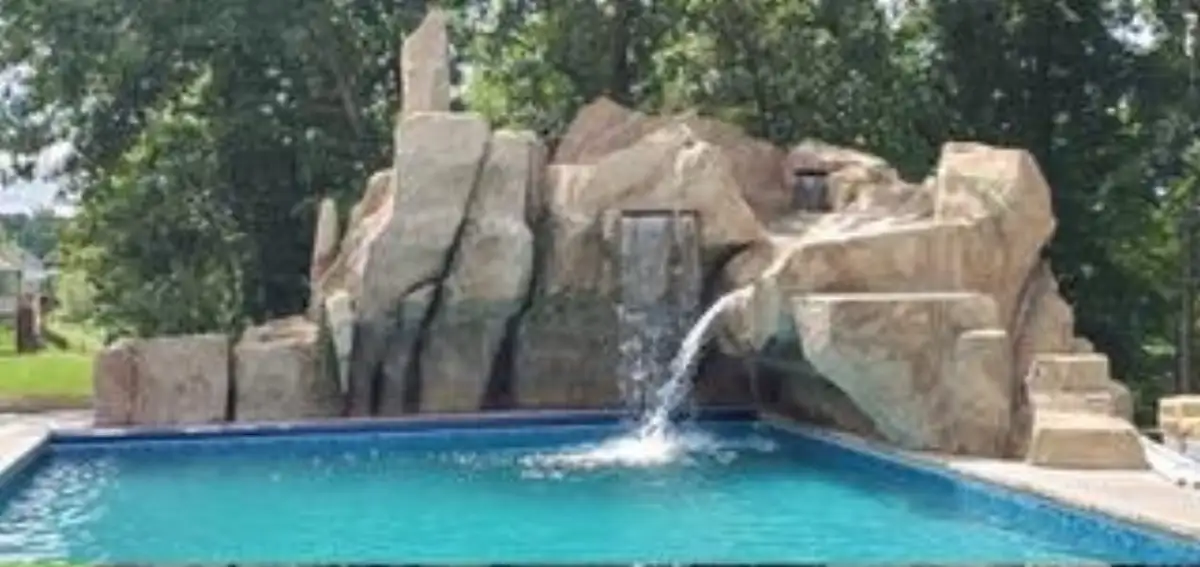
For most residential pool environments, hand-sculpted faux rock waterfalls outperform real rock in customization, structural safety, durability, and long-term maintenance. Real rock is heavy, limited by what nature provides, and prone to settling and shifting over time. Sculpted concrete gives you complete design control with engineered structural integrity.
That said, "faux rock" covers an enormous range — from cheap hollow shells sold at big box stores to hand-sculpted monolithic concrete that is indistinguishable from natural stone at arm's length. The quality gap is massive, and lumping them together does a disservice to both approaches. This article compares real rock waterfalls against properly engineered, hand-sculpted concrete — the kind we build at Boulder Legacies.
The Weight Problem with Real Rock
This is the most under-discussed issue in pool waterfall design. Natural rock is heavy. A single decorative boulder can weigh 500 to 2,000+ pounds. A real rock waterfall feature might place 5,000 to 15,000 pounds of concentrated load on one section of your pool deck or surrounding structure.
That kind of weight creates three problems:
- Foundation requirements — Most residential pool decks are not engineered for point loads of several thousand pounds. Adding real rock often requires supplemental footings, grade beams, or even helical piers — all of which add cost and disruption to the project.
- Settlement over time — Even with proper foundations, real rock features settle. The ground compresses. Joints open. Rocks shift. What was tight and aligned at installation develops gaps and movement over years.
- Structural risk to the pool shell — Concentrated weight near a pool wall can cause soil pressure changes that stress the shell. Pool builders who have been in the industry long enough have seen cracked bond beams from poorly supported rock features.
Hand-sculpted concrete waterfalls, by contrast, use a lightweight EPS foam core with a 12,000psi fiber-reinforced shell. A feature that looks like 10,000 pounds of natural stone might weigh 1,500 to 3,000 pounds total — distributed across a purpose-engineered footer, not concentrated at random rock-contact points.
Customization: Sculpted vs. Found
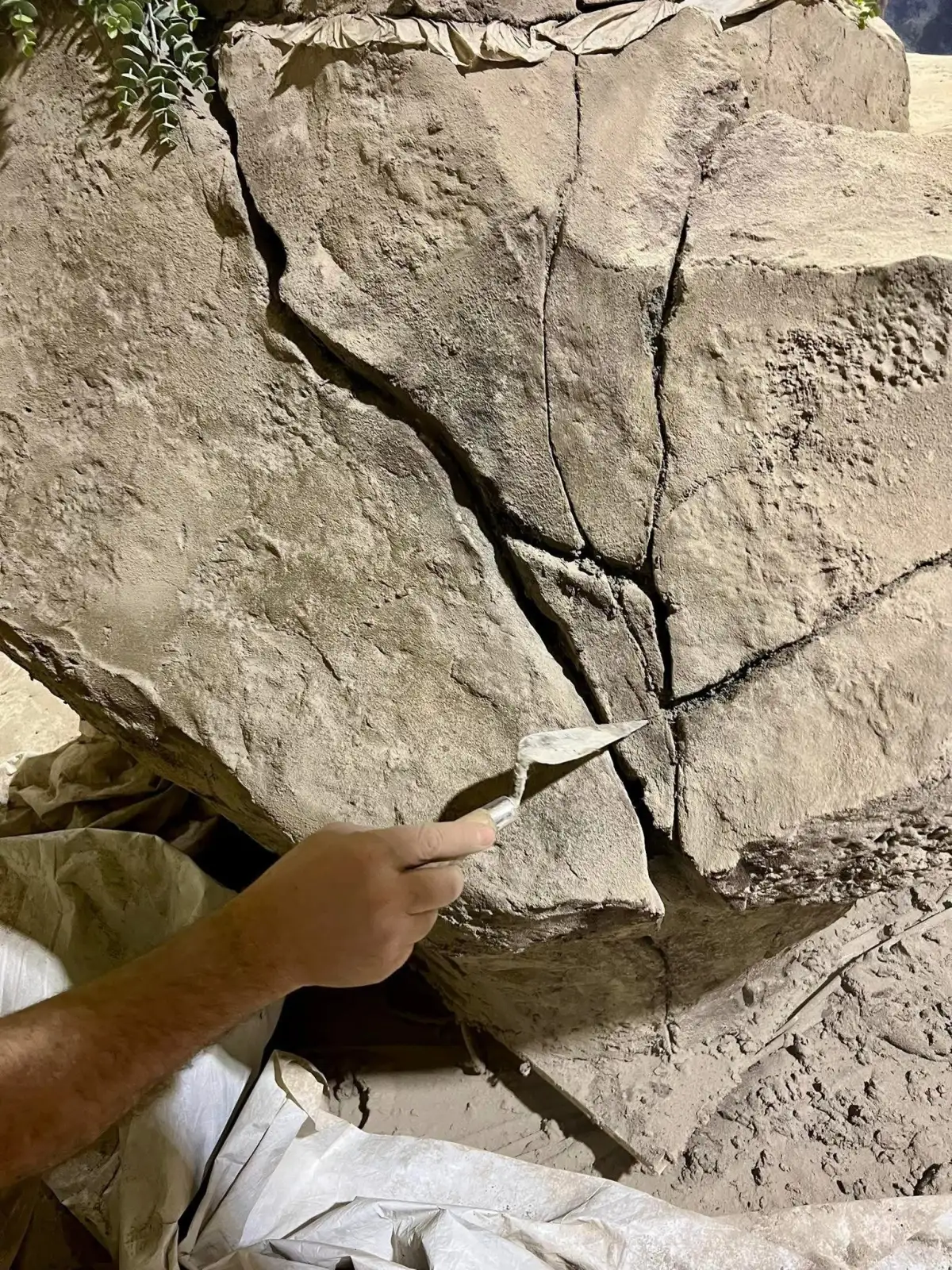
When you work with real rock, you are limited by what nature provides and what the quarry has in stock. You can select individual pieces, but you cannot reshape them. The builder arranges rocks to approximate a natural formation, working within the constraints of available shapes, sizes, and textures.
With hand-sculpted concrete, the only constraint is physics. We start with your approved maquette — a 1-inch-to-1-foot scale clay model — and sculpt the full-size feature to match it exactly. Want a specific cascade pattern? A particular overhang depth? A texture that references sandstone on the left and basalt on the right? All achievable. The material bends to the design, not the other way around.
This is particularly important for features that integrate multiple elements. A grotto entrance with an interior cave, a polished slide emerging from a rock face, and a fire bowl on the adjacent shelf — that kind of integration is only possible when every surface is sculpted to connect seamlessly. Real rock assemblies cannot achieve the same continuity. For a deeper look at grotto-specific design, read our pool grotto design ideas guide.
Durability and Structural Longevity
This is where construction method matters most. At Boulder Legacies, every feature is built with:
- Basalt reinforcement — This is the critical difference. Steel rebar rusts when exposed to moisture. Rust expands. Expansion cracks the concrete from the inside out. Basalt reinforcement is inert — it does not corrode, does not expand, does not compromise the structure over time. In a pool environment where water exposure is constant, this distinction is not optional.
- 12,000psi fiber-reinforced shell — Standard residential concrete runs 3,000 to 4,000psi. Our shell material is engineered for structural applications and resists cracking under thermal cycling, freeze-thaw exposure, and constant water contact.
- Monolithic construction — The entire feature is one continuous structure. No seams, no joints, no connection points that can separate. Water flows over a unified surface, not between assembled pieces.
Real rock features, by comparison, rely on mortar joints between individual stones. Mortar is the weakest link in any masonry assembly. Freeze-thaw cycles, thermal expansion differences between rock and mortar, and ongoing settlement all stress these joints. Repointing mortar joints every 5-10 years is a standard maintenance expectation for real rock features in pool environments.
Cost Comparison
Upfront costs for real rock and hand-sculpted concrete are often comparable, which surprises many clients. The reason: real rock is cheaper per unit, but the installation labor is more expensive. Moving, placing, and mortaring multi-ton boulders requires heavy equipment, experienced masons, and significantly more time on site.
Where the cost picture diverges is in long-term maintenance:
- Hand-sculpted concrete — Periodic seal coat (every 5-7 years), occasional touch-up staining if desired. No structural maintenance required for 30+ years.
- Real rock — Mortar joint repointing every 5-10 years (significant cost per service), potential re-setting of shifted stones, drainage management behind the feature, and settlement monitoring.
Over a 20-year period, the total cost of ownership for a real rock waterfall typically exceeds that of a hand-sculpted feature by 30-50%.
Maintenance Differences
Day-to-day maintenance for both types is similar — keeping the pump running, managing water chemistry, and clearing debris from cascade surfaces. The differences emerge in long-term structural maintenance.
Hand-sculpted concrete features are essentially maintenance-free from a structural standpoint. The monolithic construction means there are no joints to fail, no stones to shift, and no mortar to deteriorate. The waterproofing and densification applied during construction protect the surface at the molecular level.
Real rock features require ongoing vigilance. Water finds every gap. Behind real rock, moisture can accumulate and cause efflorescence (white mineral deposits), algae growth in mortar joints, and ice damage in freeze-thaw climates. Some of these issues are cosmetic. Others, like mortar joint failure behind the waterline, can create leaks that are expensive to diagnose and repair.
Visual Authenticity
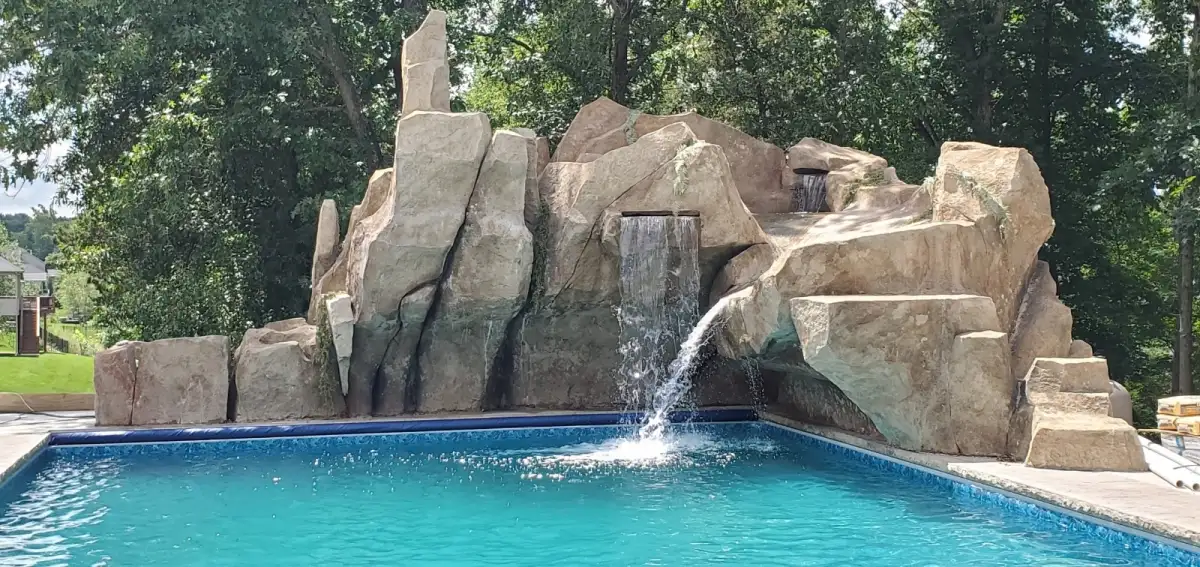
This is the question everyone asks: "Can you really tell the difference?" The honest answer depends entirely on the quality of the sculpting.
Low-quality faux rock — the prefab shells and spray-on coatings — looks artificial from across the yard. The textures are too uniform, the colors are flat, and the proportions feel wrong. This is what most people picture when they hear "faux rock," and it is why the term carries a stigma.
Hand-sculpted concrete at the level we produce is a different category entirely. Sculpting mortar — Type S mortar enhanced with Tru Pac X additive — applied at varying thicknesses (0.5 to 5 inches) creates natural contour variation. Multi-layer acid staining and oxide washes produce the depth, mineral streaking, and color variation found in real geological formations. At arm's length, most people cannot distinguish a hand-sculpted feature from natural stone. At touching distance, they notice the surface is slightly smoother — but that is usually perceived as a positive, not a tell.
Real rock, of course, is real rock. It has natural texture and color that no reproduction can perfectly duplicate. If geological authenticity at the mineral level is your priority, real rock is the answer. But for 95% of residential pool environments, the visual difference between expertly sculpted concrete and natural stone is imperceptible to anyone who is not a geologist.
The Complete Comparison
| Factor | Hand-Sculpted Concrete | Real Rock |
|---|---|---|
| Weight | 70-80% lighter (EPS foam core) | Heavy — 5,000-15,000+ lbs typical |
| Customization | Unlimited — sculpted to design | Limited by available stone shapes |
| Durability | 30+ years, monolithic, no rust | Mortar joints degrade 5-10 years |
| Cost (Upfront) | Custom — priced per project | Comparable upfront, varies by stone |
| Cost (20-year Total) | Lower — minimal maintenance | Higher — ongoing mortar and settling repairs |
| Maintenance | Seal coat every 5-7 years | Repointing every 5-10 years |
| Appearance | Indistinguishable at arm's length | Natural geological texture |
| Foundation Needs | Standard engineered footer | Supplemental footings often needed |
| Integration | Seamless — grottos, slides, fire | Limited by stone geometry |
| Freeze-Thaw | Excellent — no joints to fail | Mortar joints vulnerable |
When Real Rock Makes Sense
We are not dismissive of real rock. It has its place. Landscape retaining walls, dry-stack accents, and features where geological authenticity is the primary design goal can all benefit from natural stone. In regions where local stone is abundant and affordable — and where the design does not require integration with pools, slides, or water features — real rock can be the right choice.
But for pool waterfalls specifically — where weight, water exposure, structural integration, and long-term durability all matter — hand-sculpted concrete is the superior engineering solution. It is not a compromise. It is a different, more advanced construction method that happens to look identical to the material it references.
Making the Right Choice for Your Property
The decision between faux rock and real rock comes down to priorities. If you value complete design control, lightweight construction, seamless integration with other pool features, and minimal long-term maintenance, hand-sculpted concrete is the clear choice. If geological authenticity at the mineral level matters more than any other factor, real rock has an edge.
For most of our clients, the conversation ends when they see a completed Boulder Legacies feature in person. The craftsmanship speaks for itself. We are happy to connect you with past clients who can share their experience — or you can see our gallery and judge for yourself.