
How Much Does a Custom Pool Waterfall Cost in 2026?
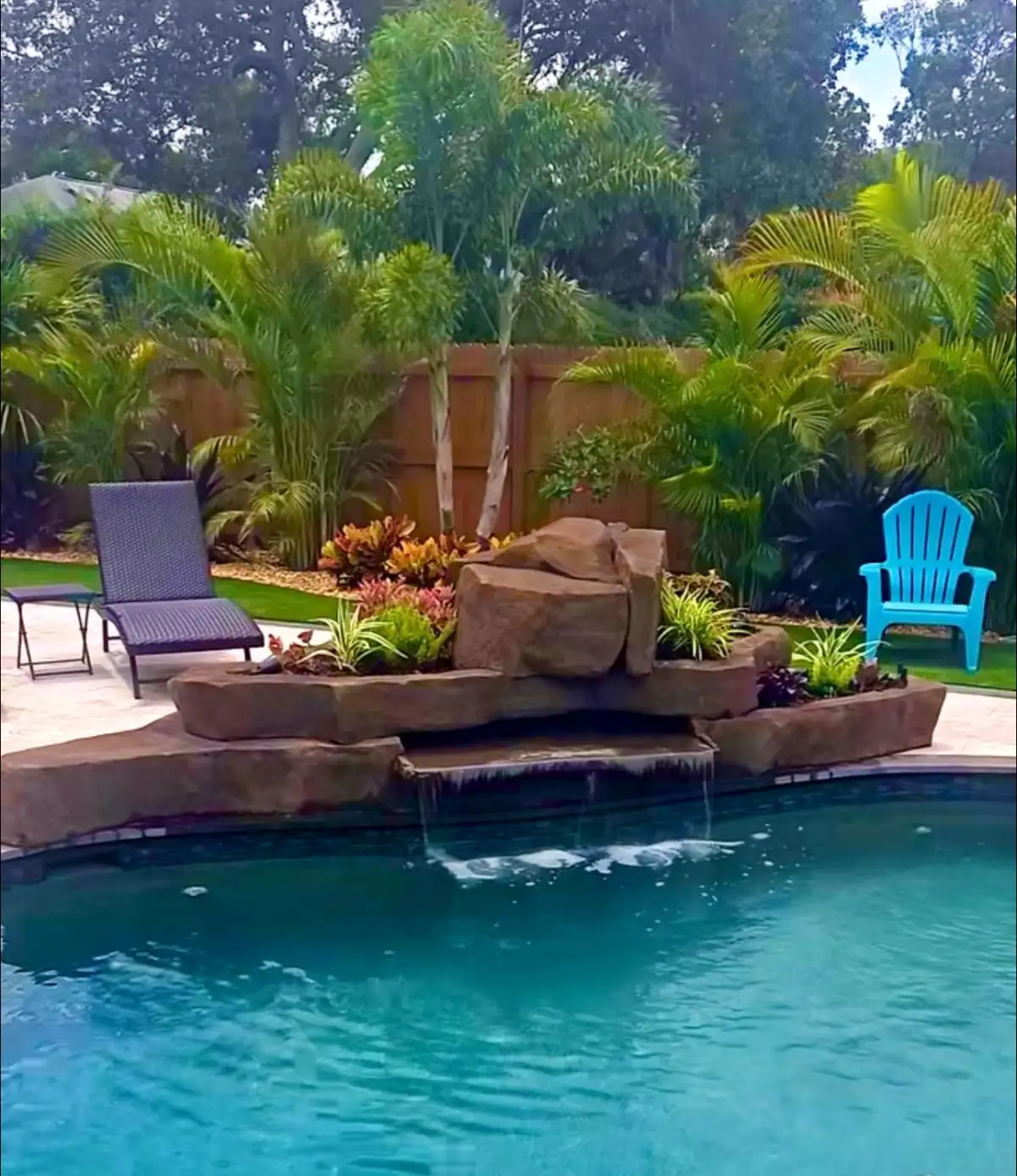
Custom pool waterfall pricing varies significantly based on size, complexity, and site conditions. No two sculpted waterfalls are alike — and the variables that determine investment are worth understanding before you pick up the phone.
I have been hand-sculpting pool waterfalls for over a decade. Every project starts as raw foam, steel-free basalt reinforcement, and 12,000psi fiber-reinforced concrete — and finishes as a monolithic structure that looks like it was carved from the earth. This article breaks down exactly what drives the cost, what you get at each price tier, and why the construction method matters more than most clients expect.
What Drives Custom Pool Waterfall Costs?
Six primary factors determine your project's investment level. Understanding each one will help you have a more productive conversation with any builder — and will help you compare proposals accurately.
1. Size and Height
This is the most obvious cost driver. A 4-foot waterfall cascading from a raised bond beam is a fundamentally different structural challenge than a 12-foot multi-tier feature wrapping around a grotto entrance. Larger features require more material, more labor hours, more engineering consideration for water flow, and more finishing detail to maintain visual authenticity at scale.
Height also affects the pump system. A 10-foot vertical drop needs significantly more water volume to look proportional, which means upgraded plumbing, larger pumps, and more sophisticated manifold design to split flow across multiple cascade points.
2. Complexity and Design Integration
A standalone waterfall on one side of a pool is simpler than a feature that wraps around a grotto entrance, incorporates a polished concrete slide, and transitions into seating walls on both flanks. Each additional element adds structural connections, mortar transitions, and finishing layers.
Grottos in particular add substantial cost because they require interior finishing, integrated lighting conduit, seating shelves, and waterproofing on all interior surfaces — not just the exterior cascade face.
3. Site Access and Conditions
Building a waterfall on an open lot with equipment access from three sides is straightforward. Building the same waterfall behind a completed home with a 36-inch gate and an existing pool deck requires materials to be moved by hand, equipment to be craned over structures, and significantly more labor hours for the same result.
Soil conditions, slope, drainage patterns, and proximity to the pool shell also affect foundation requirements. Some sites need additional footer engineering. Others need retaining structure behind the feature to manage grade changes.
4. Materials and Engineering Method
This is where the real cost differentiation happens — and where cutting corners creates problems that surface years later. At Boulder Legacies, every waterfall uses:
- Foam core sculpted base — lightweight, shaped to exact design specifications
- 12,000psi fiber-reinforced cementitious shell — structural integrity that exceeds most residential concrete applications
- Basalt reinforcement — not steel. Basalt does not rust, does not expand, does not crack the shell from the inside out. This is non-negotiable in any feature near water.
- Sculpting mortar — Type S mortar enhanced with Tru Pac X additive, 0.5 to 5 inch thickness variation for natural contour and texture
- Waterproofing at all water-contact zones
- Densification at waterlines and any slide surfaces
- Full sealant application for long-term durability
Each of these materials costs more than the budget alternatives. But they are the difference between a feature that lasts decades and one that starts cracking in five years.
5. Finishing and Color Work
The mortar and staining phase is where a sculpted waterfall becomes convincing or falls flat. Multi-layer acid staining, oxide color washes, and hand-painted detail work create the depth and variation you see in natural rock formations. A basic single-color finish costs less. A museum-quality multi-layer finish with lichen simulation and mineral streaking takes days longer.
6. Plumbing and Electrical Integration
Water delivery systems for sculpted waterfalls are not off-the-shelf. Each feature needs custom manifold design, specific GPM calculations for visual effect, and integration with the pool's existing equipment pad. Electrical work includes pump circuits, underwater lighting, and accent lighting conduit embedded during construction — not added afterward.
Price Ranges by Tier
Based on projects we have completed across the country, here is how custom pool waterfall costs break down by scale.
Small Features
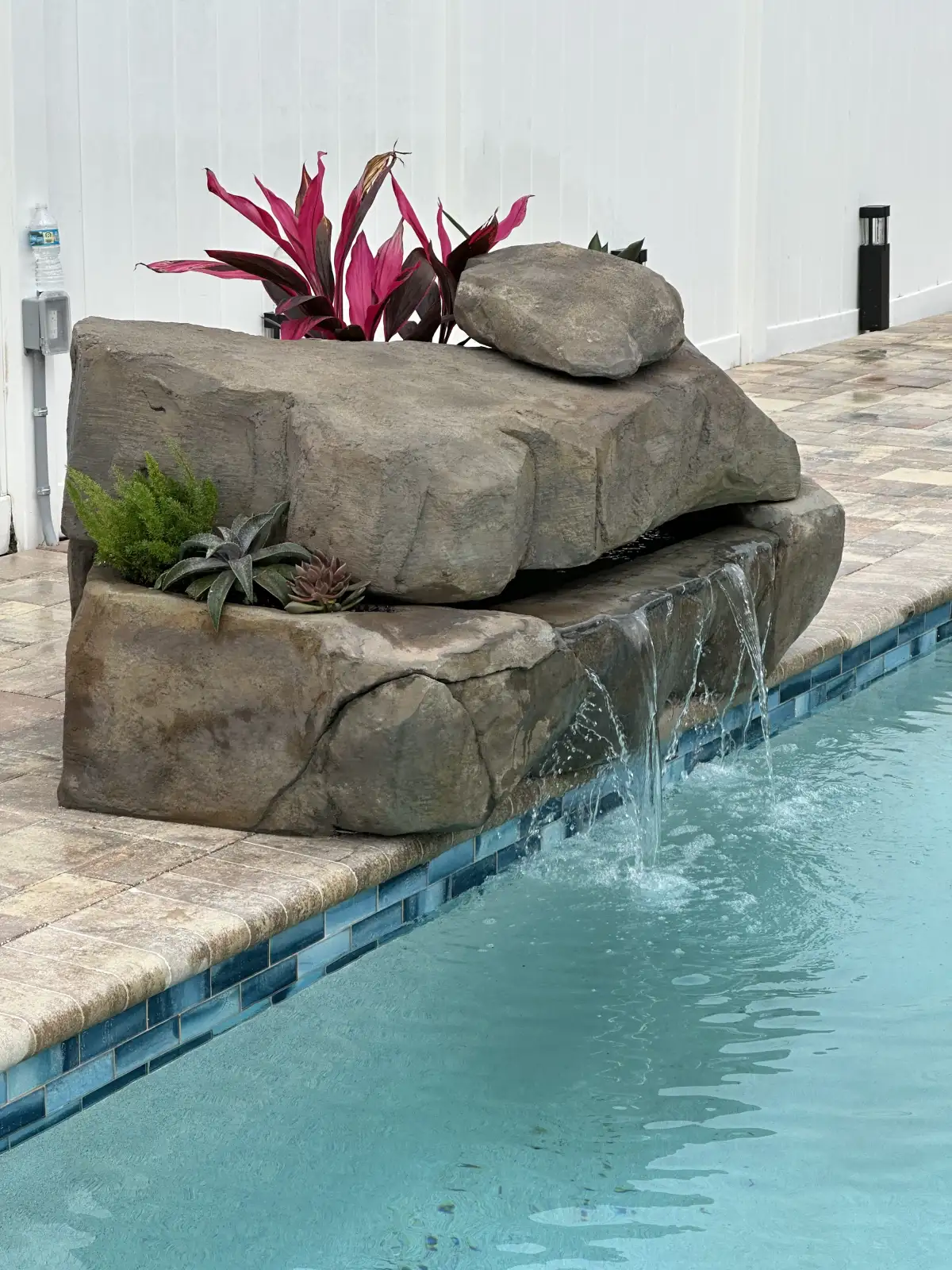
These are compact waterfalls in the 3 to 6-foot height range, typically positioned on one side of the pool. Ideal for adding a sculptural focal point without major structural modification. Includes single-cascade or double-cascade flow, integrated plumbing, standard finishing, and full waterproofing.
At this tier, you are getting a genuine hand-sculpted monolithic feature — not a prefab shell. The construction method is identical to our larger features, just at a smaller scale. Common examples include raised bond beam waterfalls, spillover features, and accent boulders with integrated water flow.
Medium Installations
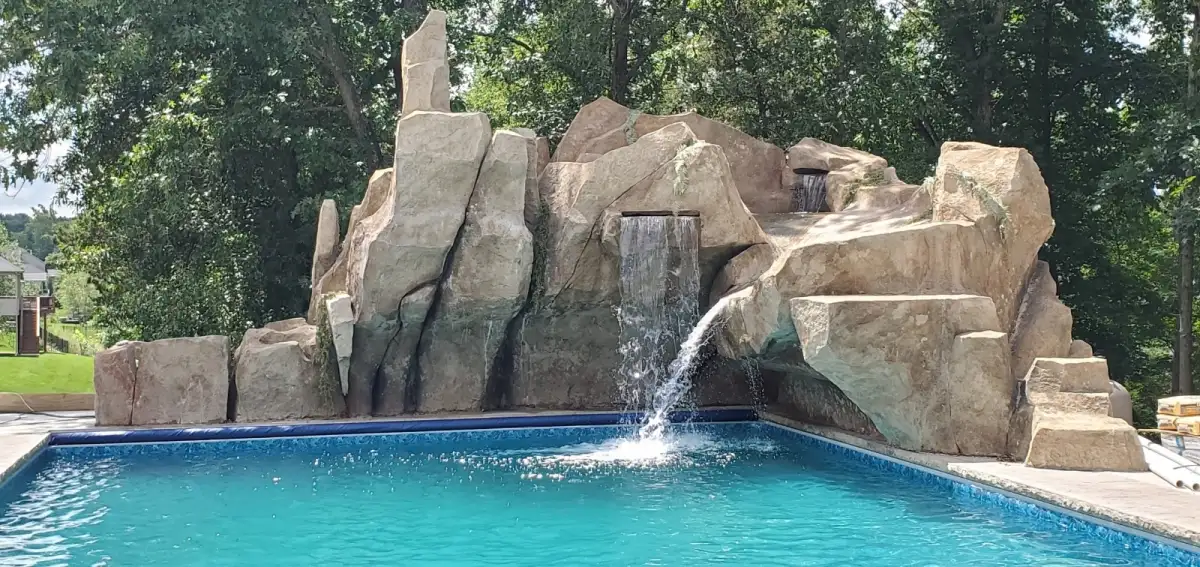
This is where most residential projects land. Features in the 6 to 10-foot range with multi-tier cascades, integrated planters or seating, and more complex finishing. This tier often includes partial grotto openings, slide integration, or fire feature combinations.
At this scale, the maquette process becomes especially valuable. A 1-inch-to-1-foot scale clay model lets you see exactly how the feature relates to your pool, your deck, and your sight lines from the house — before a single foundation is poured.
Large and Estate-Scale
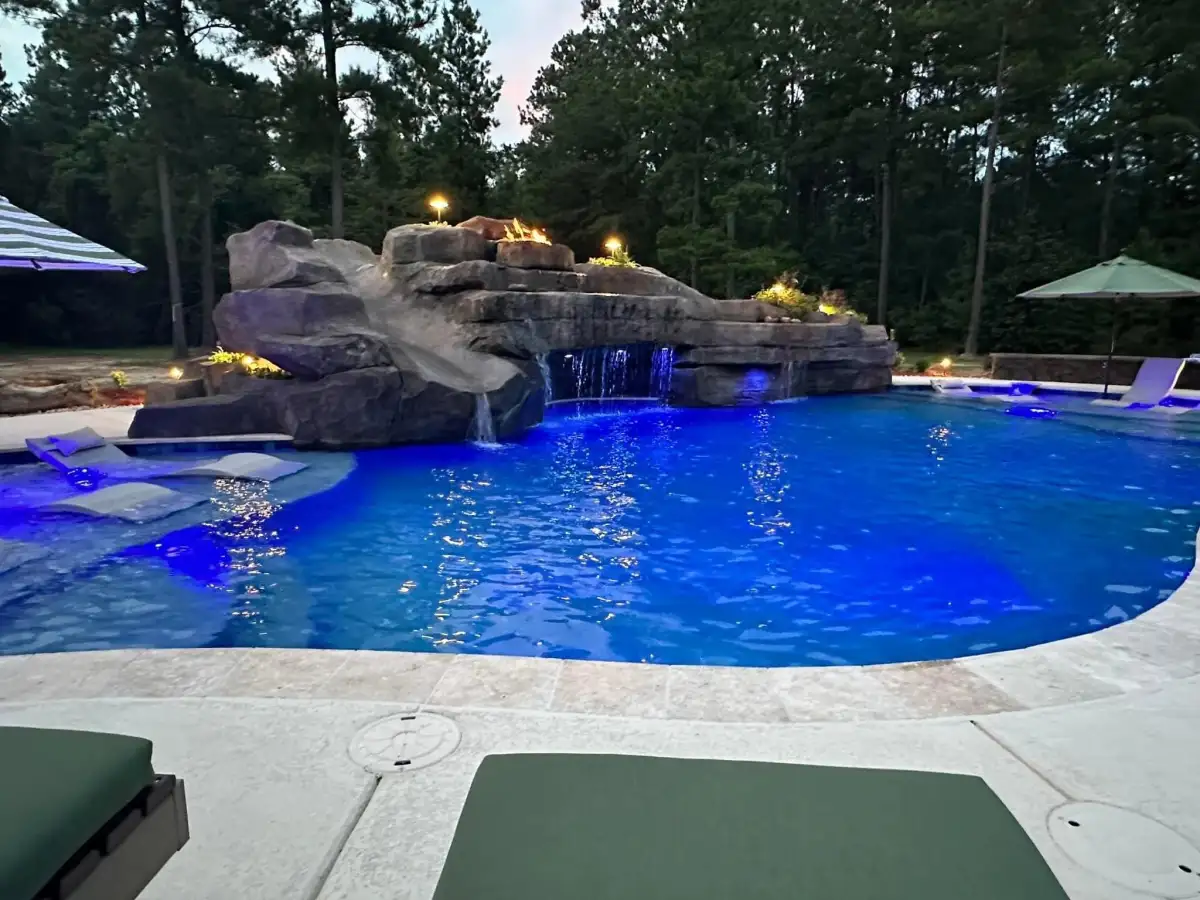
Estate-scale features include full walk-through grottos, multi-level waterfalls exceeding 10 feet, integrated polished concrete slides, and comprehensive environments that wrap around significant portions of the pool perimeter. These projects often include fire feature integration, custom lighting design, and landscape boulder transitions.
At this tier, the project is less about a single feature and more about creating a complete sculpted environment. Construction timelines extend to 4-8 weeks on site, and the design phase is more involved — often requiring multiple maquette iterations to get the flow, proportions, and integration points exactly right.
Why Hand-Sculpted Costs More Than Prefab — And Why It Matters
Prefabricated waterfall kits and GFRC (glass fiber reinforced concrete) panel systems exist at lower price points. They serve a different market. Here is the honest comparison:
| Factor | Hand-Sculpted (Boulder Legacies) | GFRC Panels | Prefab Kits |
|---|---|---|---|
| Construction | Monolithic — one continuous structure | Assembled panels with seams | Molded shells, bolted together |
| Customization | Unlimited — sculpted to your design | Limited to available panel shapes | Fixed catalog shapes only |
| Structural Strength | 12,000psi shell + basalt reinforcement | Moderate — panels can flex | Lightweight — cosmetic only |
| Rust Risk | Zero — basalt reinforcement, no steel | Low — glass fiber, no steel | Varies — some use steel frames |
| Seam Visibility | None — seamless construction | Visible at panel joints | Obvious at connection points |
| Lifespan | 30+ years with minimal maintenance | 10-20 years before panel degradation | 5-10 years before replacement |
| Cost Range | Custom — priced per project | Moderate | Lower upfront |
| Resale Value Impact | Significant — architectural feature | Moderate | Minimal — often removed by buyers |
The cost difference between hand-sculpted and prefab is real. But amortized over a 30-year lifespan versus a 7-year lifespan, the per-year cost of a sculpted feature is often lower. And unlike prefab, a hand-sculpted waterfall never needs to be "replaced" — it is part of the landscape, permanently.
The Design Engagement — What It Covers
Every Boulder Legacies project begins with a Design Engagement. This is not a deposit that disappears into overhead. It funds a specific deliverable: your 1-inch-to-1-foot scale clay maquette.
Here is what the process looks like:
- Site consultation and measurement — We visit your property, assess the pool structure, measure available space, evaluate access, and discuss your vision in detail.
- Maquette sculpting — Within 7-10 days, we hand-sculpt a physical clay model at 1-inch-to-1-foot scale. One inch on the maquette equals one foot on the finished feature.
- Client review — You review the maquette in person or via detailed photography. Modifications are made until you are fully satisfied with the design.
- Approval and project proposal — Once approved, the maquette becomes the construction blueprint. Your Design Engagement fee is applied in full to the project cost.
The maquette process eliminates the biggest risk in custom construction: building something that does not match expectations. You see and approve the exact design — proportions, textures, flow patterns — before construction begins. No other builder in this space offers a physical model you can hold in your hands.
What Is Included in the Price
When you receive a proposal from Boulder Legacies, the price includes everything required to deliver the finished feature:
- Design consultation and site assessment
- 1-inch-to-1-foot scale clay maquette (hand-sculpted)
- All materials — EPS foam core, basalt reinforcement, fiber-reinforced shell, sculpting mortar
- Complete on-site construction
- Custom plumbing integration with existing pool equipment
- Waterproofing at all water-contact zones
- Densification at waterlines and slide surfaces
- Multi-layer finishing and color work
- Full sealant application
- Electrical conduit for lighting (lighting fixtures specified separately)
- Final walkthrough and handoff
Items typically not included: landscape restoration around the construction zone, lighting fixtures (we specify and install conduit, client selects fixtures), and permits (we handle the application, client pays fees). These are disclosed upfront in every proposal.